






About the Authors

... See All Posts by This Author

Daniel J. Pilla

Should We Cancel the National Debt?

Mr. Pilla is a tax litigation consultant and author of eight books on successful methods of dealing with IRS abuse. He is editor of the Pilla Talks Taxes newsletter and has appeared on over 2,500 radio and TV talk shows discussing taxpayers’ rights issues.

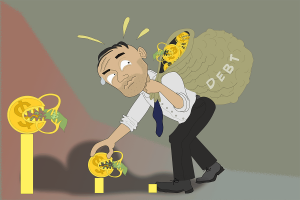
This question is popping up more and more. The idea of canceling the debt seems to gain support in direct proportion to the increase in the debt itself. Should we or shouldn’t we? At present levels, the national debt is about $5 trillion. It grows by hundreds of billions each year. Current levels of federal spending will add about $1 trillion more in debt over the next four to five years.

As the debt grows, government’s interest burden grows with it. The more of our tax dollars consumed by interest, the fewer dollars available for discretionary spending. What’s worse, more pressure is then exerted to use tax increases to fund mandatory spending programs, such as Social Security, Medicare, and Medicaid. To illustrate how the interest burden is growing, consider this: in 1963, the federal government spent just 6.9 percent of its total budget on net interest. By 1993, the total interest outlay was 14.1 percent of total spending. But judging interest as a percentage of spending is not the real story. We all know government spends more than it collects. The federal interest burden exists simply because government, like you and me, must actually service its debt. Interest, of course, represents the cost of debt service.

To see a true measure of the problem, we should examine interest payments as a percentage of revenue collected, not as a percentage of total spending. Congress only spent a total of $92.642 billion in 1963. What’s more, the federal government ran a very small deficit. As a result, the amount of interest paid as a percentage of revenue collected was still around 6 percent. By 1993, however, Congress collected $1.153 trillion, and spent $292.502 billion on net interest. That puts the interest component of total federal revenue at 25.3 percent of revenue collected. As you can see, that is nearly double the less telling number of 14.1 percent.

This problem is exacerbated when we add to the mix the question of entitlements. Entitlements include those programs which guarantee a payment to citizens. Chief among them are Social Security, Medicare, and Medicaid, but entitlements also include federal pensions of every description. As these mandatory spending demands increase along with interest payments, the government’s latitude to spend elsewhere, including for defense, is greatly inhibited. Consider this observation from the opening remarks of the Final Report of the Bipartisan Commission on Entitlement and Tax Reform. At page 4, we are handed this most sobering bulletin: “The gap between federal spending and revenues is growing rapidly. Absent policy changes, entitlement spending and interest on the national debt will consume almost all Federal revenues in 2010. In 2030, Federal revenues will not even cover entitlement spending.” (emphasis added)

Even if Congress resolved to balance the budget tomorrow (which we know it will not do, since it turned away the Balanced Budget Amendment), it will continue to face and be forced to handle interest on the $5 trillion debt it has already amassed. Market conditions, not the government, will dictate what interest rates will be paid. As a result, the question of its interest burden is largely uncontrollable.

The next question then is, why not begin paying off the debt? That of course is what a reasonable person would do, and that is what every American family would have to do under similar circumstances. But before it would make sense for you to start paying off your debt, before it would do any good for you to do that, you must first stop going further into debt. And this the federal government has steadfastly refused to do.

In his Wall Street Journal article of February 9, 1995, Stephen Moore, director of fiscal policy studies at the Cato Institute, discussed some problems inherent in paying off the existing national debt. The following is a portion of Mr. Moore’s observations:


Here’s an experiment. What if we were to try to pay off the $4-plus trillion national debt by having Congress put one dollar every second into a special debt buy-down account? How many years would it take to pay off the debt? One million seconds is about 12 days. One billion is roughly 32 years. But one trillion seconds is almost 32,000 years. So to pay off the debt, Congress would have to put dollar bills into this account for about the next 130,000 years—roughly the amount of time that has passed since the Ice Age. Even if we were to require Congress to put $100 a second into this debt-buy-down account, it would still take well over 1,000 years to pay the debt down. (emphasis added)

Neither Moore nor Cato has specifically called for repudiating the national debt. However, others have. And the call is not new, but facts as sobering as those Steve Moore presented provide fuel for the fire. The day Moore’s article appeared in the Journal, Rush Limbaugh began talking about repudiating the debt. Like Moore, he did not specifically say the debt should be repudiated. However, he misunderstood the clear message of the article.

The underlying premise of the article was not to suggest or argue for repudiation of the debt. Rather, it was to emphasize the magnitude of the problem and to create a sense of urgency for the idea of a balanced budget. As I said earlier, the debt cannot even begin to be addressed until we begin to live as a nation under a balanced budget. That is the mandatory first step. Without taking that step, nothing else matters. Instead of realizing that point from the article, Rush Limbaugh used the facts presented to jump to the conclusion the debt could “never be paid.” He did not specifically state it should be repudiated, but he did say economists should begin to address the ramifications of doing so. In response to a caller who phoned with his position on the matter, Rush contended he did not understand the full ramifications of repudiating the debt, and thus stopped just short of making the claim.

To Repudiate or Not

So, my question to you is, based upon the above facts, should we repudiate the debt or not?

Before we answer the question, let us understand exactly what constitutes the “national debt.” We hear the term over and over, but we also hear much misinformation about it. For example, we should begin by learning to whom this debt is owed. Many times, politicians will say, “We owe it to ourselves.” In fact, one of the callers to the Rush Limbaugh program that day said, “If we owe it to ourselves, why not just repudiate it?” If you owed your home mortgage to “yourself,” you might be inclined to cancel the debt. And if you did, what difference would it make? Who, if anybody, would be hurt by that act? If you truly “owed it to yourself,” perhaps nobody would be hurt.

Let us understand, however, that the United States does not owe the money “to itself.” Just as you owe your home mortgage to the organization that loaned you the money to allow you to purchase it in the first place, the federal debt is owed to specific creditors. How does one become a creditor of the United States? To finance its deficit spending, the federal government must do exactly what you and I do before we can spend money we do not have. It must first borrow that money. When the United States borrows money, it must enter into a promise to repay the debt. It is no different than your home mortgage. If you borrowed $100,000 to buy or refinance a home, you must guarantee the bank you will pay back the principal, with interest at a stated rate, within a stated period of time.

Bonds and Bondholders

When the United States borrows money, it does much the same thing. Instead of signing a mortgage note, however, government issues debt instruments. The debt instruments assume three forms. Long-term debts take the form of bonds, medium-term debts take the form of notes, and short term debts take the form of bills. When the United States overspends by, say, 300 billion in a given year, it raises the money to pay the difference by issuing these debt instruments. The Treasury first decides how much of the debt is to be financed through long, medium, or short term obligations. It then offers these obligations to the public through an auction. For simplicity’s sake, I will refer to all government debt instruments as bonds.

The government debt instruments— bonds—are purchased at auction at a discount to their face value. The deeper the discount, the higher the rate of interest the government will pay to the bondholder. The smaller the discount, the lower the rate of interest the Treasury will pay. The bond discount rate, and hence the interest rate, is largely determined by Federal Reserve interest rate settings and the market place. The point is, government does not set the rate. Bonds are sold, like anything else at auction, to the highest bidder, assuring the lowest rate for that particular issue.

The bond is an obligation not unlike your own mortgage note. The United States agrees to pay the bondholder a specific principal, at a stated interest rate over a fixed period of time. The entirety of the federal debt, some $4.8 trillion, is financed in this manner. Thus, the United States does not owe the money to “itself,” it owes the money to bondholders. They are the parties who lent their cash to the government to finance its operations.

But who are these bondholders? When the Treasury offers bonds for auction, the largest segment of the bonds are purchased by major brokerage houses. Institutions such as Salomon Brothers and Merrill Lynch purchase major blocks of these debt instruments. They in turn resell them to individual investors. Of course, they sell them at a rate which allows the brokers to make money on the transaction. However, the brokerage fee can easily be avoided by purchasing bonds “Treasury direct,” which in effect, bypasses all broker middlemen.

The ultimate purchasers of government bonds fall under three categories: (1) foreign governments, (2) institutional investors, such as banks, insurance companies, mutual funds and pension funds, and (3) individual citizens. This answers the question “To whom do we owe the money?”

In the February 1995 Treasury auction of two- and five-year notes, we find that more than $25 billion was raised through “competitive tenders from the public.” In addition, another $1.5 billion was awarded to “Federal Reserve Banks as agents for foreign and international monetary authorities.” (See Public Debt News, U.S. Treasury Department, February 22, 1995.)

Repudiation Fallout

Now that we understand to whom we owe the debt, let us explore the likely consequences of repudiating the debt. I have classified the fallout into three types of problems: small scale, medium scale, and large scale. Let us take them in ascending order.

Small-Scale Problem. From the government’s point of view, a small-scale problem is created for the individual holders of government bonds. If the federal government defaults on payments, those owners—a person here, a person there—lose part of their savings. To the extent that that person invested to save for his retirement, to build a college fund, or to buy a home, that money is lost. Is that the end of the world? Ask the guy who loses his savings. If he’s young enough to recover over time, maybe not. Maybe he can swallow the fact that his money was stolen from him by a dishonest government. Maybe he can work extra hard in the remaining productive years he has left to make up the difference. Maybe.

What about those millions of older or retired citizens who have invested heavily in government bonds because of the “guaranteed” safety and return on investment? Suppose such a person is 65 years old. Suppose his entire life savings is invested in bonds, and he is dependent on the interest every month to keep him out of soup lines. How will that person recover from having his money stolen from him by a dishonest government?

Medium-Scale Problem. If you’re not an owner of government bonds, what do you care? If those people were shortsighted enough to put all their eggs in one basket, maybe they deserve what they get. Maybe you don’t have to worry because your money is invested with your insurance company, or mutual fund, or even better, in your company’s pension fund. But maybe you should worry.

The largest investors in government bonds are institutional investors such as these firms and banks. With nearly $3.5 trillion in pension cash alone invested throughout the world, a huge share of that money is in “guaranteed” government bonds. There are hundreds of billions more invested through insurance companies. Add to that the billions in mutual fund investments and you start to appreciate the problem is quite a bit broader than just a few old people losing some spare change.

I submit to you that if you have any kind of life insurance policy, pension fund, or mutual fund investment of any kind, you are the proud owner of federal government bonds at some level. If the government defaulted on these obligations, it would send shock waves through the entire financial market. It would destabilize much of the insurance and pension sector, and could spell the outright destruction of countless mutual funds. Even if you do not own an insurance policy or pension fund of any kind, I would be surprised if you did not have a bank account. Banks also invest heavily in government bonds.

I suspect that if the federal government were to default on bond debts owed just to the banking industry, the fallout would make the S&L crisis look like a mere bank overdraft. In fact, by defaulting on government bonds owed to banks, my guess is the entire commercial banking industry would be destabilized, risking the money of every depositor, large and small.

Large-Scale Problem. But even if the financial markets were rocked, pension and insurance funds were lost, and millions upon millions of American citizens lost money to a dishonest government through bank closures, that is not even the worst of it. The worst is the effect it could have on our world trading partners and military allies. Hundreds of billions more in federal debt are owned by foreign governments, foreign insurance companies, and foreign mutual funds. Japan alone has helped finance American deficit spending for decades, to the tune of billions. If the federal government defaulted on debts owed to these foreign investors, our government would likely face financial retaliation of immeasurable proportion.

For example, I could well imagine all assets of U.S. investors in foreign nations being frozen by that government. You don’t think that can happen? The United States does it all the time. Remember the Gulf War? After Iraq invaded Kuwait, some $2 billion in Iraqi assets held in U.S. banks were frozen by executive order of President Bush. If we can do it to foreign investors in the United States, why can’t foreign governments do it to U.S. investors?

And that may not even be so bad. What could be worse is the prospect that a foreign government may nationalize the assets of U.S. companies located in that country. By the way, the term “nationalize” is how governments refer to the act of stealing what does not belong to them. Is it all that hard to imagine, for example, the government of France or Germany nationalizing the assets of Ford Europe in an effort to recoup its own losses? During the 1950s, U.S. businesses lost billions when Castro’s government took over Cuba and nationalized all U.S. assets held in that nation.

Even if the affected foreign governments did not openly retaliate against U.S. assets held in their country, what effect do you suppose repudiation of debt will have on our military alliances? Do you suppose the governments of the Western world will be so quick to jump to the aid of any United States interest after they have had billions stolen from them by a dishonest government? Don’t bet on it.

The bottom line is, repudiation of the federal debt would be fundamentally immoral. It would constitute a dishonest act of the highest order. The ramifications would be felt in every home in the country, and every capital in the world. The United States could be ruined politically, financially, and perhaps militarily. After all, how many of our government’s military actions are financed through borrowing?

But, as the saying goes, every cloud has a silver lining. If the government of the United States repudiated its debt to investors, you can be sure we would have a balanced budget, whether Congress liked it or not. That is because nobody would ever lend the United States another dime!

There Are 17 Responses So Far. »

  1. More Americans Are Saying: “It’s Not Our National Debt” – Join the Revolt!
    Washington has bailed out the banks, Wall Street & their Washington special interests and much of the cost is added to the national debt to by paid by this and future generations while real estate and investments continue to fall. The Campaign to Cancel the Washington National Debt By Constitutional Amendment is starting now in the U.S. See: http://www.facebook.com/group.php?gid=67594690498&ref=ts

  2. The real problem:
    No one filled out a form 28 to mortgage their property to the US. Looking at title 46 ANYRHING registered to the US is US Collateral. THAT MEANS WE ARE ALREADY CREDITORS need to figure out how to get official recognition as a Creditor or when this nations economy falls through bye bye property !!!

  3. As is probably appropriate in an economics journal, the effects you describe are utilitarian. But yours is a one-sided analysis. You do not mention the continuing harm done to generation after generation in paying the interest on the debt. How about a section on “Non-Repudiation Fallout”, or can you imagine no ill effects other than our inability to go back into collective debt again to fund our military aggression?

    I agree the most compelling argument is moral. But your assertion that defaulting on the debt is immoral depends on the assumption that those in power have legitimate righteous authority to act as our proxies in incurring the debt.

    I disagree. They do not.

    Our “representatives” in congress, aren’t. They are advocates for powerful special interests and in no way do they represent the individuals burdened with their borrowing. They certainly don’t represent me. When was the last time your “representative” called you to ask your preference prior to voting on a bill?

    One is morally obligated to keep ones word. But one is not obligated to keep someone else’s word. Americans are NOT morally bound to honor this debt any more than any other slave is morally bound to honor the promises made by his Master.

    So the Master’s credibility is ruined? Tough. So the people to whom the Master made these promises are harmed? They are in that position because of their willingness to benefit from slave labor. I think your sympathy is misplaced, sir. Your sympathy should be for the slaves, along with mine.

  4. [...] liked it or not. That is because nobody would ever lend the United States another dime!" Should We Cancel the National Debt? | The Freeman | Ideas On Liberty For more opinions on "repudiate the national debt" this search should help……. [...]

  5. check out my FinancialReform website

  6. Mr. Pilla concluded, “The bottom line is, repudiation of the federal debt would be fundamentally immoral. It would constitute a dishonest act of the highest order.” Fine.

    But how much less “fundamentally immoral” or less of a “dishonest act of the highest order” would it be when the federal government pays off expiring bonds or the interest on current bonds with counterfeit money, a.k.a., “Federal Reserve Notes”? As everyone may know, these “notes” are money fresh off the printing press (or “credit” that were created out of thin air that are deposited to people’s bank accounts). And as everyone may also know, these printing press notes, or “fiat money” have no store of value, a fundamental quality of real money. Indeed, while the value of this “fiat money” depreciates almost by the minute and even by the second, economists are wont to always cite “inflation adjusted” figures to compare money values from the past, as if it were a trifling. (“Babe Ruth’s salary in 1922 would be $50,000,000 when adjusted in 2010 dollars.”)

    And while “Moral Skeptic” previously said on Dec 8, 2009 that he does not sympathize with those lenders who would lose big time should the government repudiate its debt because those lenders were willing to profit from the “slave labor” required to pay off the debts and their interest, Mr. Pilla sees a “silver lining” should the federal government repudiate their debt: “That is because nobody would ever lend the United States another dime!”

    That would be great. But why wait until the government repudiate its debt to stop lending the “United States another dime”? Everyone should IMMEDIATELY stop lending the government anything. NADA! ZILCH!

    Another good policy is for bond holders to threaten to cash in their bonds unless the government does any number of things, such as: stop spending, end the war in Iraq, repeal “Obamacare,” take real steps to pay down the debt, stay out of China’s policy towards Taiwan (as the Chinese government, the biggest foreign lender, might insist) and whatever else.

    Do you own federal bonds? Just think of what you and thousands of other holders of federal bonds might do if you get together and demand the federal government do your “pet project” lest you cash in all those bonds.

    Do you think the federal government might consider doing that “unpatriotic,” “subversive” or even “treasonous”? If they do, GOOD!

  7. Money is representative of resources used. The acceptance of money is a social compact that allows
    inter-individual debt of resources to be offered to another person regardless of relation to the original
    debt.

    Money cannot exist without debt. For instance, if I go into the wild and obtain seeds for a vegetable
    garden. I then proceed to live alone in the wilderness producing my own sustenance without the aid or
    interaction of any other person. I am indebted to no one. Therefore there is no need to exchange
    money. Any exchange of currency or commodity without the need is useless. The need arises from
    owing a debt to another person.

    The problem is that money represents debt due to the reception of a service provided which takes up
    resources unavailable to the person indebted. Money is not directly representative of the service only the
    debt owed. Money as the exchange of debt is agreed upon by society so that it may provide itself with
    justification of not owing towards expended resources. Money cannot be created without the expenditure
    of resources.

    A direct representation of calling in debt can be illustrated as this. I have built a fence for you. This
    fence is meant to keep away animals that would otherwise eat your grain. You provided all apparent
    required resources to have the fence built. However, there were resources you could not supply; such
    as my time, and the wear and tear on my body. Since I have expended something of mine for you, you
    are in debt to me. To represent this debt you give me money. This money represents the work I have
    done for you and the debt you then owe me. I can take this money and go purchase a sack of flour
    made from the grain in the field I fenced off, thereby keeping the animals out, to allow your grain to
    grow and be made into flour to be purchased by me. You debt is no longer to me. In this case I have
    utilized the money provided to me as a representation of debt directly towards the source of the original
    debt.

    An indirect representation would be if I then took the money you gave me and purchased any number
    of things that have nothing to do with the fence, your grain, the animals, or anything that had any
    amount of reasonable connection to the action I provided to you that put you in debt to me.

    Debt is Representative of Resources Expended

    Now, before the fence is ever built you and I have agreed upon what you will owe me. You will owe
    me a bushel of apples, or 10 otter skins, or $100. In the United States of America, in A.D. 2009, the
    agreed upon method of representation of debt is the dollar (or even less tangible the electronic
    representation of a dollar). This dollar represents nothing other than the promise of a society that it (the
    dollar) is worth something; this is almost as good as Mr. Minuits beads. So I will inevitably take the
    $100 to build the fence, and in turn to give it for exchange of flour or whatever else.

    For an accurate representation of debt to be presented the unreturnable resources that account for the
    debt must first be tallied and agreed upon. The task conducted is not what is being paid for, it is the
    resources that were used performing the task.

    For the instance of building a fence we will look at the resource of time. If I have a long weekend,
    and on this weekend I have no plans or intentions to do anything particular with one of the days in this
    weekend, then this time may be less valuable than time I would have spent building my own fence with
    my son. If you want me to build your fence in the time allotted for building my own fence, then the time
    (the resource of that specific instant of time) could be much more valuable to me and therefore increase
    the amount of debt you owe me.

    Each resource used accounts for an amount of debt owed, like when you bring your car to the
    mechanic and get charge for parts and service. Now let us think about that “part” you bought for your
    car. You don’t even know what it is, it is just a thingamajig that makes your car go. Why in the world
    does it cost $100? Well, remember you are then paying for its parts and services, from locating and
    extracting the raw materials in the earth, to the gasoline it takes the plant worker to use to get to work to
    build the part on the conveyor system the company had to buy, etc., etc. You are paying for all of that
    because it all requires resources. You paid for these resources buy selling the grain you grew behind the
    fence I built. You sold the grain, instead of giving it away, because it cost you the resources of time and
    land space to grow it. And so on and so forth as everything is connected in this way.

    Circular Debt

    Although money is circulated, it cannot travel in a redundant circular path. I cannot owe you $20,
    and then you borrow $20 from me without me first paying you back. In this case we would both owe
    each other $20 causing a grand total of $40 worth of debt. The original $20 that I owed you was for
    apples from your orchard that I was not able to pay you for, say I left my wallet at my house. Then the
    $20 you come to owe me is for 5 fence posts you needed to complete your fence, I happened to have
    some extra with me in my truck and you said go ahead and use those for now; so that you wouldn’t
    have to spend your time and effort going back to town to get more fence posts, I just spent my posts for
    you. So even though there has been a total of $40 worth of resources utilized the debt we have to each
    other is actually zero. But, since we use money to represent the debt, this creates a self-contradiction.
    There is now a representation of debt greater than the actual debt. To fix this we must sit and identify
    the amount of represented debt we owe each other and find the corresponding lost resources, if there are
    no resources lost then there is no debt incurred.

    Trading Debt for the Benefit of More Debt (or Debt Lotteries)

    Paying money for nothing creates the illusion of accrued debt. For instance when you buy life
    insurance, you are paying for the privilege to accrue debt. You are essentially exchanging your debt so
    that your family can become indebted to strangers. Every month you exchange money (money
    representing that somebody else owes you something) so that when you die the insurance group you
    were paying the money to can give your family a lot more money than you ever paid the insurance group
    (hopefully!?!). Now since your family received money from all these other people, they are indebted to
    them.

    Life insurance is extremely spectacular in that everyone who pays into it will have the money they
    paid for paid out (probably), so that you in your living state are paying money to another dead persons
    family. You are in turn paid back by a living family paying the debt of the family you paid to die by
    paying your family when you die. Fantastic. In a situation like this the only method of sustainment is for
    each generation of people paying into the group to be larger than the previous group of people. For these
    exchanges of money no resources are being spent, other than those created by the moving of money,
    which are self-fulfilling; since you cannot have one without the other. You cannot spend the resource of
    moving money if money is not moved.

    Like the insurance problems, social programs used for the support of individuals are flawed in that
    there is an imbalance of debt owed to the individual and the amount of resources used to support that
    individual. In this case, like with insurance, each subsequent generation supports the generation that
    precedes it and must therefore be larger than the generation it is supporting. This requires continual
    growth to continue. This growth may sometimes need to be forced and unnatural.

    Paying health and similar insurances is like gambling for debt. These practices are intended to draw a
    large representation of debt, money, from many people by having each person turn over smaller amounts
    of money than the possible payout. The company managing the insurance then intends to pay out a
    single larger sum of money to a few individuals. These practices are simply debt lotteries.

    Exchanging the representation of debt for other nothings, such as health insurance, only complicates
    matters further. In the instance of health insurance, you are paying for the probability of getting ill or
    injured. When you get ill or injured you go to the hospital and your insurance pays a certain amount of
    money. If everybody that paid into the insurance pool got ill, injured, or otherwise withdrew from the
    pool, then there would not be enough money to represent the amount of resources used to tend to the
    health needs of all the people. Therefore, the insurance group is hoping that people it owes money to do
    not claim the money they are owed. They hope that the debt they intentionally accrue is forgotten by
    those who are owed. Hope in one hand and spit in the other, see which fills up first. Though this
    problem can be corrected with the assurance, not insurance, that each individual requiring health care
    pay the debt themselves, and not through a group. All debts are redeemable from the individual whom
    causes the use of resources to occur.

    Interest is a False Representation of Debt

    Accruing interest on a sum of money (remember, money is only the representation of debt) is
    creating a false account of resources used. Interest is accrued by allowing an entity to use the debt you
    are owed to force other entities into creating more debt. This interest gained creates a false
    representation of the amount of resources owed to the person accruing interest. If you start off being
    owed $20 worth of fence wire, then accrue .05% interest on the money representing the amount fence
    wire owed, then it appears as though you are owed $20.01 worth of fence wire. If the debt is called out
    and you must be paid back with the equivalent amount of fence wire owed, then you will only get the
    original $20 worth of fence wire. You will then be left with $.01 of imaginary debt owed to you that you
    will never rightfully obtain, because no resource has been expended to create that debt of $.01.

    Resources can only truly be paid back in kind; silicone for silicon, 93% lean ground beef for 93%
    lean ground beef, time spent for time spent. No amount of gold can repay you a debt of wood when all
    you need is warmth from the cold air. Perhaps paper money may suffice in providing the flame that the
    wood would otherwise provide, but this would be a very highly inflated debt price of money to produce
    the heat warmth equal to that of the owed measure of wood. If you exchange all the food you ever own
    in for money representing the debt of food owed to you, you will inevitably die of starvation.

    How Profit is Made

    Profit is having more people owe you than the amount of resources you have expended. This can be
    accomplished in two ways. When you control a resource that is more valuable to the person desiring it
    than it is to you, or to the majority of the society in which you live, then it may be possible to cause the
    person to owe you a disproportionate amount of debt to obtain the resource. In this process the person
    paying a disproportionate amount of debt is forfeiting an amount of debt owed to them by another person
    to you. Since you are gaining more owed debt than the resources you have lost, you are gaining profit
    of debt. Somebody who never owed you anything now owes you something by way of the person
    wanting your resource passing the debt onto you to gain that resource. The origin of profit is this third
    person whose debt to the second person is passed on to you (you are the first person).

    However, profit from money debt is imaginary, until the resources owed are actually returned, there
    is no profit. So long as money is held, traded, and used; no profit is gained. If someone owes you 50
    pounds of sand, and they pass profit of debt onto you in the form of 5 pounds of sand, then you will
    never make a profit until you obtain the 50 pounds of sand from them and to 5 pounds of sand from the
    origin of profit. Once all of your resources are obtained you now have 55 pounds of sand, which is 5
    pounds more than the 50 you originally were owed by the second person.

    The origin of the value of debt is decided on by whoever is in control of the expended resource. If
    you need a log of wood to keep warm right now, and I have the log of wood it is my choice on the value
    of the wood. I give you my log in exchange for any amount of debt that you agree to owe me. If the
    log is worth $10 then we agree on $10, if it is worth $50 then we will agree on $50. The provider of a
    resource is the final say in how much a resource is worth to them. It is they who will dictate what debt
    is owed to them by providing the resource. The balance of value comes from the desire to have someone
    owe debt to you rather than someone else. I would rather have you owe me $10 worth of debt than for
    you to owe someone else $15 worth of debt. Therefore I will lower the value of my $50 of wood to
    $10; thusly, you will choose to owe the debt to me since it is less debt than that of the $15 dollar man.

    Value of Resources

    Resources are only as valuable as the activity with which they can be utilized. Gold is worthless if it
    is not used. Gold is of value if it is used to perform a desired action. Gold is a natural occurring
    resource that has traditionally been used as a representation of monetary value. However, this is an
    intangible utilization of gold. A few tangible uses for gold are as jewelry or electronics. As jewelry gold
    can be pleasing to the eye and can increase overall joy in its observer, whether it be the owner or not,
    and thereby has tangible value by improving life through beauty. Gold is also a good conductor of
    electric current. When used to conduct electric current, the gold is performing a task and thereby holds
    the value associated with that task. Gold is also an easy way to consolidate large quantities of debt into
    physically small areas. In this way gold is allowing the condensation of the physical space in which hard
    currency, money, takes up; thusly serving a purpose and being valuable for that. However, to have gold
    and to call it money without moving it is a false sense of holding debt. If it is not put to task or utilized
    for a job, then it is worthless.

    Forced Inflation of Debt

    Expenditure of resources without cause is forced inflation of debt. This type of resource expenditure
    is not sustainable and will cause a greater crush of debt. For example, without your direct consent I
    build you a fence on your property. When I am done with you I dictate that not only do you owe me for
    the resources used, but how valuable the resources are. You then owe me a debt. Not only do you owe
    me a debt but you now must spend resources keeping the fence up to local building codes in accordance
    with laws. I have just forced debt upon you.

    Now, at such a micro level of two individuals this seems highly improbable. However, at macro
    governmental levels this is very common. For instance, sometimes roadway are so damaged that they
    need to be repaired or replaced. This is very understandable and reasonable. However, sometimes
    roadways are replaced without the expressed need by the people who use the roadway. The local, state,
    or federal government will initiate a project that utilizes resources (such as manpower and roadway
    materials) to replace the roadway. Now the cost of this roadway falls on the population deemed
    responsible for the roadway. This populace now owes a debt to all those involved with replacing the
    roadway, and they never had any direct say in the process. This is forced debt inflation. An outside
    agent forces the utilization of resources on a populace causing the populace to owe debt, and causing an
    unnatural scarcity in the resources used in the project.

    Social Agreement to Utilize Standard Debt Representation

    Agreeing to use money is agreeing to allow the accumulation of debt unrelated to the resources
    required to perform the action for which the debt is owed. Because, we cannot all perform all tasks
    related to our needs and desires we have agreed to use money to represent what is owed to us in a larger
    arena than the locality of the individual who owes the debt. If you owe me $50 worth of medicine, and
    either of use leave the vicinity of the other there is no valid way of proving that a debt is owed to me or
    by you. By me holding onto your $50 bill I can represent to anyone that I have spent $50 worth of some
    resource. And by you no longer having the $50 shows that you are in debt, albeit indirectly by you not
    being able to further utilize the $50 in representation of owing debt for something else. And by the
    compact accepted by our society I can trade the debt you owe me for a debt I now owe somebody else.

    A society agreeing that a form of money is representative of the debt agrees to not repay debt owed.
    Once the utilization of money is accepted in a society, all participating members of that society choose to
    forgo repaying resource debts. This way the representation of debt can be equally assessed by any
    member of the society to ensure equal value for the money which represents the debt. No matter what
    resource was used to gain $1 in debt that $1 is equal to any other $1 worth of debt. A debt of $1 worth
    or gold is equal to a debt worth $1 in fence posts; though the resources may be different in quantity or
    quality, the amount of debt is the same.

    However, for members not participating in the society of money this does not hold true. If you are
    lost in the forest and you come across my home, where I live alone and sustain my own life, your
    money may not mean anything to me. Since you are lost, let’s assume that you are also hungry. You
    have a $10 bill and you offer me that $10 bill in exchange for 5 pounds of carrots that I have grown. I
    will not accept your $10 because it is not an accurate or agreed upon representation of carrot debt to
    me. And since I am the original controller of the carrot resource, it is I who dictates the value of the
    resource. Now you are carrying a pack of cigarettes, which I desire since it has been a long time since I
    have had a smoke and it would be nice to have one. So, we can come to agree that for every half pound
    of carrots is worth 1 cigarette. Here we have traded a resource for a resource, and there is no debt.

    A Statement on Original Resource Control

    Since original control over a resource is where the value of the resource is identified it is prudent to
    identify this: Obtaining original control over a resource is a cyclical process which requires control of
    another resource that provides the ability to take over the resource in question. Simply put, you cannot
    gain something without first having the means with which to gain it. The true original owner of a
    resource date back to the farthest antiquity to the creation of ownership and to the one who created such
    an idea. It is from that point which original control over a given resource is transferred through trade or
    conquest. .

    The Purpose of Exchanging Controlled Resources and the Value of Debt

    The purpose of exchanging controlled resources are:

    To accumulate an amount of debt owed to you so that when you are unable to maintain self-reliance
    you can call in those who owe you and be supported by their returning the necessary resources for you
    to continue to survive. Without the debt of resource owed to you, as proved by the amount of money
    you have, there may be no way to support your livelihood or life. This easily identifies the major problem
    with the “living alone in the wilderness” scenario. It is that upon the time which you are no longer able to
    maintain survival on your own, there are no debts to call in and suffering will ensue. To maintain this
    method of life any resource thrift or exchange must be made with durable foodstuffs and shelters that
    will provide for your survival until your death.

    To protect the remainder of one’s own resources from be taken by another person

    To take another person’s resources for your own

    To obtain any personal desire that requires the efforts of other people.

    To cooperate with an established society in which the change of the society is of greater difficulty
    than the desire to change it provides; thereby, maintaining a status quo that requires the complex
    cooperation of a large number of resistant individuals.

    A Statement on Charity and Goodwill

    Goodwill and charity are not accounted for in this, as in their true form they do not cause debt to be
    counted. The giver of goodwill and charity, in their true forms, is simply sacrificing their resources for
    the return of no thing.

  8. My comment got blocked last time, I guess it was to long.

    It is posted here, http://www.trueliberty.us/Money.html

    Or click my name. This is a short essay on the origin of money and the meaning of debt, how debt comes to exists and the false belief of debt being a benefit. It is pretty interesting and is a bout a20 minute read.

  9. [...] who have been favorable, even enthusiastic, about debt default include Murray Rothbard, Dan Pilla, and Christopher Whalen. In 1995, then House speaker Newt Gingrich publicly warned the Public [...]

  10. [...] who have been favorable, even enthusiastic, about debt default include Murray Rothbard, Dan Pilla, and Christopher Whalen. In 1995, then House speaker Newt Gingrich publicly warned the Public [...]

  11. THE NATIONAL DEBT ISA NOT YOURS. READ MORE AT INTERNETFREEPRESS.COM

  12. [...] who have been favorable, even enthusiastic, about debt default include Murray Rothbard, Dan Pilla, Jeffrey Rogers Hummel, and Christopher Whalen. In 1995, then House speaker Newt Gingrich publicly [...]

  13. Anyone having taken economics 101, would know how the national debt is structured and knows if we were to default would make our current down turn look like a grade school picknick, we would see 40% of the retired go broke overnight, we would see most of our banks, credit unions brokerage houses IE WALL STREET disapeer, we would see stockbrokers falling from every window in New York and nearely all our businesses would fold, 8.9% unemployment try 70% the U.S. as we know it would be gone and Yes every Marxist, leftist and progressive would be dancing in the streets, they could move in lock, stock and barrel and would…. So we’de better keep the presure on our government to figure ways to reduce it or else.

  14. @BLUFART,

    While that may be true, what will happen if we don’t default? When you look at the total outstanding public and private debt in the US, paying it off would require either massive inflation leading to the same outcome you noted above, or the allocation of such a large percentage of national income that our economic output would decline drastically, again leading to the same outcomes you have noted. I challenge anyone to come up with a formula for paying off this debt that will not inflict severe and prolonged pain on the people of the United States. I will point out that we are not alone because the situation is even worse in Europe and Japan. All three dominions, US. Europe and Japan, are conspiring to keep this pyramid scheme of fiat currency afloat. Meanwhile, the nations that will assume the new economic leadership of the world are preparing for the inevitable collapse of the world’s reserve currency – the US dollar – by trading their dollars for gold and other hard assets, which the rest of the world will have to buy from them in the future.

  15. So what becomes of the US Goverment, when the final bill comes. Are we to worry or just go on with our heads stuck in the ground, as most people love to do. Some Americans love to be ignorant to reality.

  16. [...] times Should We Cancel the National Debt? | The Freeman | Ideas On Liberty Should We Cancel the National Debt? This question is popping up more and more. The idea of [...]

  17. Hold on just a minute!

    Blufart (haha!) and Brian: how do you know what a US government default on debt would like?

    I don’t think it would look anything at all like Blufart’s doom-and-gloom scenario, and Brian, yours is just as bad. Why don’t you fellas take a look at the link (written by economist Jeffrey Rogers Hummel) and tell me what you find.

Post a Response

  • © Copyright 2011 Freeman - Ideas on Liberty. All rights reserved.

    88 queries. 1.226 seconds